A cathedral setting is a ring style where the band arches up on either side of the center stone to support it, the way buttressed arches support a cathedral ceiling. The metal does the lifting instead of the prongs alone, so the stone sits higher and catches more light from the sides.
People pick a cathedral for three reasons: the elevated profile makes the stone look larger and more brilliant, the arched silhouette is distinctive when viewed from the side, and the structure is genuinely traditional rather than just trend-driven. The trade-off is that the raised metal snags on knitwear, gloves, and hair, the recessed corners trap soap and lotion, and the extra metalwork costs more than a basic four-prong solitaire of the same carat weight.
Below are seven cathedral-style rings currently available on Amazon, ranked by overall value, followed by a section on what to look for when shopping this setting.
Cathedral Engagement Rings Compared


3 CT Emerald Cut Moissanite Ring
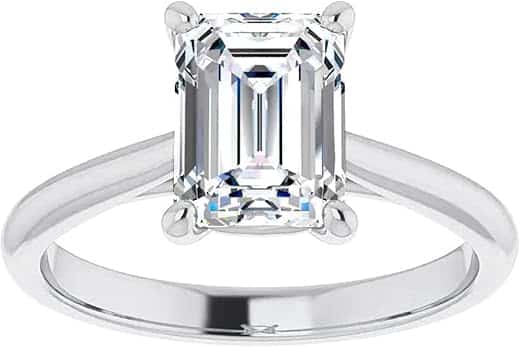
A 3-carat emerald-cut moissanite set in 14K white gold with a cathedral shank. The step-cut faceting reads as crisp and architectural rather than sparkly, and the elevated mount gives the long stone room to show off its profile.
A 3-carat emerald cut is a large stone, and the elongated step-cut shape is best displayed when it sits up off the finger. The cathedral shank does exactly that. Solid 14K white gold, with moissanite prongs that rise off the arch.
No buyer reviews are posted yet at the time of writing, so the score reflects spec and construction rather than wear feedback.
1.50ct Round Moissanite Engagement Ring
A 1.5-carat round Forever One moissanite in a cathedral mount, with a hidden halo of small natural diamonds tucked under the head. Available in white, yellow, or rose 14K gold.
The hidden halo is the design point worth paying for. A ring of small diamonds sits in a collar around the base of the center stone, so straight-on the ring reads as a clean solitaire, but a side angle shows a glint of pave under the moissanite. The cathedral arches make that halo visible.
Pave settings catch dirt faster than a plain band, so plan on cleaning the halo with a soft brush and warm soapy water every few weeks.
14K Yellow Gold Cathedral Semi Mount
A semi-mount in 14K yellow gold: the cathedral structure ships without a center stone, designed so you can drop in your own diamond, moissanite, or heirloom stone. Best for buyers planning a custom build.
Yellow gold reads warmer against most skin tones and contrasts more clearly with a colorless center stone than white gold does. Band width is 4.5mm, resizable by a jeweler.
14K White Gold Lab Grown Solitaire
A 1-to-5 carat lab-grown diamond in an Asscher cut, set in a 14K white gold cathedral solitaire. Lab diamonds are physically identical to mined stones and cost roughly 60 to 70 percent less.
An Asscher cut is a step-cut square with cropped corners; it shows clarity flaws more than a brilliant round does, so picking lab-grown lets you specify a higher clarity grade at a workable price. 30-day return policy.
Classic Round Solitaire Engagement Ring
A 0.5-carat round cubic zirconia in a six-prong cathedral-style mount on rhodium-plated base metal. Sold as a budget option or a travel/placeholder ring, not as a forever piece.
Rhodium plating eventually wears off base metal, exposing the underlying alloy; expect noticeable wear within a year or two of daily use. Fine for short-term wear, not a primary engagement ring for the long haul.
Moissanite Cathedral Classic Enhancer
Not an engagement ring itself — a ring guard/enhancer with a 1-carat round moissanite, made in 14K rose-gold-plated sterling silver. Wraps around an existing engagement ring to add visual width.
An enhancer is worn alongside an existing engagement ring, not in place of one. Rose-gold plating over sterling silver wears off faster than solid gold, so think of this as a fashion piece rather than an everyday-forever ring.
Cathedral Ring Guard Enhancer
A second enhancer/ring guard, this one in rose-gold-finished sterling silver with AAAAA cubic zirconia accents. Adjustable to fit a range of band styles. Lowest score in the lineup due to mixed durability reports.
Match this enhancer’s rose-gold finish carefully against an existing engagement ring; metal tones rarely align perfectly across brands, and the mismatch is visible up close.
Bottom Line
For a solid-gold cathedral ring with a real center stone, the 3 CT Emerald Cut Moissanite Ring (#1) delivers the most stone-per-dollar in this lineup and benefits most from the elevated profile a cathedral provides. If a brilliant round shape is the priority and budget allows it, the 1.50ct Round Moissanite with hidden halo (#2) adds a side-profile detail no plain solitaire can match. The 14K Yellow Gold Cathedral Semi Mount (#3) is the right pick if you already own a center stone or plan to source one separately. Skip the bottom three (CZ on plated base metal, enhancers) unless you specifically need a placeholder or want to layer with an existing ring.
How to Shop a Cathedral Setting
Setting structure
A true cathedral has metal arches that rise from the shank to support the center stone, in addition to (or sometimes instead of) traditional prongs. A “cathedral-style” ring may just be a standard prong setting on a raised mount. Look at the side profile in product photos: real cathedrals show clearly defined arches.
Stone options
Mined diamond stays the most expensive option. Lab-grown diamond is chemically identical, costs 60-70% less, and grades the same. Moissanite is a different mineral (silicon carbide) — slightly more brilliant than diamond, slightly softer (Mohs 9.25 vs 10), and costs a fraction of either. Cubic zirconia is a glass-like simulant that scratches and clouds within a couple of years; suitable for placeholder rings only.
Metal choices
Solid 14K or 18K gold lasts indefinitely with normal care. Plated sterling silver shows wear within 1-3 years of daily wear. White gold needs re-rhodium-plating every few years to stay bright; platinum stays the same color but costs more. Yellow and rose gold age without needing replating.
Who the cathedral suits
Best fit: office workers, people who want a traditional silhouette, anyone with a larger center stone that benefits from being lifted off the finger.
Worst fit: nurses and healthcare workers (gloves catch), kitchen staff and gardeners (food and soil pack into the recesses), competitive athletes and climbers (the raised profile snags and can deform the metal). For active wear, look at a low-profile bezel or flush setting instead.
Maintenance
Cathedral settings trap more dirt than flat-profile rings. Clean weekly with warm water, mild dish soap, and a soft toothbrush, paying attention to the underside of the head and the corners where the arches meet the shank. Skip ultrasonic cleaners on rings with pave accents or glued stones.
FAQs
A cathedral setting uses metal arches that rise from the band on either side to support the center stone, like the buttressed arches of a cathedral. The stone sits higher than in a basic prong solitaire and reads as more dramatic from the side.
Yes. The raised arches and elevated stone catch on sweaters, gloves, hair, and other fabrics more than low-profile settings do. If you work with your hands, choose a bezel or flush setting instead.
Usually yes — the arched shank uses more metal than a simple band, so for the same stone and metal type, a cathedral will run 10-20% more than a plain prong solitaire. The gap narrows on larger ring sizes.
Yes, but expect to pay more than for a plain band. The arches reach up to the head, so a jeweler usually needs to cut and re-solder near the structural shoulders. Most rings can move 1-2 sizes up or down without trouble.
Soak the ring in warm water with a few drops of dish soap for 10-15 minutes, then scrub gently with a soft toothbrush, paying attention to the underside of the head and the corners where the arches meet the shank. Rinse and dry with a lint-free cloth. Skip ultrasonic cleaners if the ring has pave accents or any glued elements.